Enamelling On Copper
Copper has been the most inexpensive and satisfactory metal for use in enameling. The thickness of copper is measured in gauge sizes. The most commonly available gauges for enamel projects are 16, 18 and 20 gauge. (The smaller the gauge number, the thicker the metal)





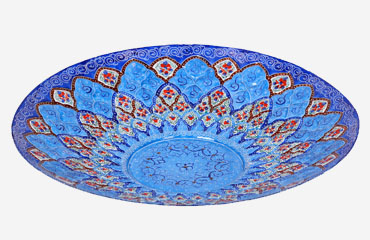





Introduction
Enameling is the process of applying a thin coat of finely ground glass to a metal. When heated to a high temperature, the glass melts and fuses to the metal.

Enameling is a vehicle for both a creative and technical art experience. The art of enameling involves the design of lines, shapes, colors and textures into imaginative images by means of the technique or craft of enameling. The practice of these techniques may take considerable experience before it is fully understood and controlled. Yet, there are many aspects of the process which allow simple steps on the way to achieving great skill.
Enamels applied to metals produce various color effects. With careful experimentation, the subtle variations in color and form can be controlled. The real joy in enameling lies in creating a design motif which exploits the brilliance of the enamel colors through technique and control. Fusing the enamel to the copper surface with heat completes a project which in the beginning existed only in one's imagination.
The processes of enameling are not difficult to learn, but should be taught and practiced in logical order to ensure good results and allow success. Most important is what is done with the knowledge gained and the skills developed and how these will differ with each experimenter. This becomes the personal and unpredictable ingredient in art called creativeness and it affords the greatest amount of satisfaction and pleasure.
Enamel on Copper
History of Enameling
Early in the 1400's someone discovered (or took a good look at the millefiori in Celtic enamel) that a design of juxta- positioned colored enamels would not intermingle when heated to their fusing temperature. Partitions were not necessary! Then someone found that one color could be applied over another with a second firing. The big discovery-thin metal-could be used if enamel was applied to both sides prior to firing. The result was a new technique called painted enamel (painting with enamel is perhaps a more accurate description). Other crafts and trades took note, made discoveries, and the Renaissance was off and running!
I t is believed that vitreous enamel work had its beginning with early civilizations around the Mediterranean from the sixth century B.C. or even earlier. Greek sculpture from the fifth century B.C. shows surfaces with areas of inlaid metal covered with enamel. The ancient Greek goldsmiths inlaid their jewelry with thin coatings of white and blue enamel between gold wires. This is one of the first examples of the cloisonné process. By the third century B.C., the enamel process had spread to England and Ireland. The process continued to move slowly from Europe to Asia Minor and the Middle East, to India and China, and then to Japan by the third century A.D.